Wednesday, September 16, 2015

Just Don't Quit Your Day Job.....

Portions of this post are included on the GoUpstate Blog, Culture Aplenty, 9/14/15

I have been an artist most of my life and  have had an active studio practice since the mid 1970's. During the 1980's my focus was on design and manufacturing of fashion and art jewelry in a business known as Jane Nodine Hardwear. The fashion business is exciting, exhilarating, and hi-energy, but it is also stressful, risky, and competitively exhausting. Trends change over night and as many of you may remember, that mood ring that was so much in demand last month is deader than a doornail the next month.

In the early 90's I began employing student interns in my business and it reminded me of how much I enjoyed my teaching in grad school. Little by little I began to gravitate toward education and in 1995 I accepted a full-time position at the University of South Carolina Upstate as an assistant professor of art and gallery director. Since that time I have taken over as coordinator of the art program and Assistant Chair of Fine Arts and Communication Studies, all while still directing the gallery and exhibition programs.


As professor of Art and Gallery director at University of South Carolina Upstate, I enjoy working with talented colleagues and eager students in the visual arts. I feel fortunate that we have received support from administrators that allowed us to develop a vital program producing qualified designers and art educators who serve this region and beyond.

As a metropolitan university, a major component of our role is to interact with the community and to create opportunities that engage business and industry with students and residents in an effort to encourage lifelong learning.

Installing work by sculpture Bob Doster on Upstate Campus.

One of the most effective ways our art program can reach beyond the campus grounds is through our gallery events that are free and open to the public. USC Upstate sponsors three exhibition spaces and a collection of monumental sculpture. This effort supports not only our academic mission to students, but has brought many visitors to campus. Being located at the crossroads of I-85 and I-26 has allowed for travelers to stop by and see the outdoor sculpture that decorates our campus and is accessible 365 days per year. 


The Curtis R. Harley Gallery, named for the late well-known Spartanburg artist Curt Harley, is located in the Performing Arts Center and sponsors regional and national exhibits with lectures and receptions from August through May each year. The FOCUS Art Education Gallery located on the second floor is our teaching model for pre-service teachers. This space provides an area where art teachers in K-12 schools from Spartanburg and surrounding counties can exhibit student work with lesson plans. It also allows K-12 students to be paired with an Upstate Art Education student for mentoring opportunities.


Curtis R. Harley Gallery in the Performing Arts Center at USC Upstate.


UPSTATE Gallery on Main, located at 172 E. Main Street, downtown Spartanburg, is our newest space. The gallery opened in January and is focused on contemporary original works of art that may veer from the conventional, while also supporting exhibits of our permanent collection that include work by Andy Warhol, Jerry Uelsmann, Beatrice Riese, Jack Tworkov and Will Barnet. By making our collection available for public viewing, students and scholars are free to utilize the works for scholarly research and the community is free to visit. Our focus on contemporary and non-conventional exhibits allows us to offer opportunities that are typically not available in our area. The overall response to the new location has provided several new opportunities to students to include internships with the gallery operations, participation in the monthly Spartanburg Art Walk and presenting the Annual Portfolio Review, where design seniors can display their work for potential clients and employers. Direct experiential learning is emphasized in the Upstate curriculum and we engage our students in all aspects of the operations and management of our gallery program. In addition to the displays and educational offerings, the space is also available for rent for receptions and meetings.

Installation by Shannon Lindsey, UPSTATE Gallery on Main, 172 E. Main St.

We are here to offer our events to Spartanburg and we invite you to take advantage of the activities that now run throughout the year. The UPSTATE Gallery on Main is open from 12 – 5 p.m. Tuesday through Saturday. The Curtis R. Harley Gallery and FOCUS galleries located on the USC Upstate campus are open from 9 a.m. – 5 p.m. Monday through Friday. All USC Upstate gallery events are free and open to the public. 


Shannon Lindsey working on her installation.

Detail view, Shannon Lindsey Installation.
Shannon Lindesy's installation is on view from September 7th to October 30th, 2015. Public receptions will be held during monthly Art Walk on September 17th from 5–8 PM and October 15th from 5–8 PM. Events are free and open to the public.

Details on the galleries can be found on Facebook: UPSTATE Gallery on Main and Curtis R. Harley Art Gallery or by contacting Jane Allen Nodine, gallery director at 864-503-5848 or email: jnodine@uscupstate.edu .


Tuesday, August 4, 2015

The Savored Line, Summer in the Studio, #thesavoredline


Summer.........and this too shall pass.....

As professor at a modest-sized university, I enjoy my job and gain knowledge and satisfaction from working with talented colleagues and eager young students. As much as I like my work and the position I have earned, it is always glorious when spring semester ends and the rains, flowers and temps of May flood the environment with delicious sounds and smells. The first week or so after school ends I tend to bask in this freedom and look forward to what seems to be a long stretch of summer before early August when the emails return with numerous duties and concerns.

I am grateful for that summer break and I do not take those times lightly. In my past career life I worked at jobs year-round, so I know how precious a summer break can be to feed the soul and rejuvenate the mind. Once I get acclimated to the new schedule, I get started on my lengthy to-do lists that include miscellaneous appointments, repairs here and there, a bit of travel, reading, reading, farmers markets, boating/laking/fishing, yoga/workout, and mostly a schedule for concentrated time in the studio.

This summer I have had a good and enthusiastic experience with the work I am developing. I started in May on a group of 24 X 24"  panels with a collaging process using wax monotypes and encaustic medium. Those have been well received and several will be included in up-coming exhibitions this fall. While working on the panels I needed to develop more monotypes on papers so I switched from the panels to the hotplate. Working with this monotype process, I am highly attracted to the qualities of that bring drawing, painting and printing into one activity. Being able to move the heated liquid on a warm surface just like paint, then marking and incising into that pool of wax and pigment, and quickly placing fibrous papers over the wet surface to grab the liquid before it sets, is a good feeling. It often reminds me of when I was printing film photography and would watch the paper give rise to images in the liquid developer. It typically renders a thrill, sort of magical.

Currently I am scheduling exhibitions of The Savored Line, and would love to hear from you if this work would enhance an upcoming project you are developing. I post dates of up-coming exhibits on my website NEWS page, and I email Jane Allen Nodine, Studio Newsan-e newsletter 4-5 times per year. If interested in the newsletter please sign-up at the link. Also join and follow me on Instagram for daily posts of what is In The Studio. 

Interaction is always appreciated and I value your visits and comments to my blog, website, and social media sites.

Follow me on:
• Facebook
• Instagram
• Twitter

• See Jane in the Studio

All work ©2015 Jane Allen Nodine.


Enjoy looking ! 


The Savored Line  


24 X 18" wax & pigment on Washi paper © 2015

24 X 18" wax & pigment on Washi paper © 2015

32 X 21" wax & pigment on Masa paper © 2015

32 X 21" wax & pigment on Masa paper © 2015

40 X 25" wax & pigment on KOZO paper © 2015

DETAIL, wax & pigment on KOZO paper © 2015

24 X 18" wax & pigment on Washi paper © 2015

DETAIL, wax & pigment on Washi paper © 2015

24 X 18" wax & pigment on Washi paper © 2015

24 X 18" wax & pigment on Washi paper © 2015

24 X 18" wax & pigment on Washi paper © 2015

26 X 20" wax & pigment on Rives lt wt paper © 2015

DETAIL, wax & pigment on Rives Lt Wt paper © 2015


40 X 25" wax & pigment on KOZO paper © 2015

40 X 25" wax & pigment on KOZO paper © 2015


#thesavoredline


Oh yes, not to forget........on the water and deep dish peach cobbler with SC peaches!!


Monday, September 1, 2014

Art and Education in a Brave New World


It's a brave new world and Dorothy doesn't live in Kansas anymore.

Like most businesses and organizations Art is seeing paradigm shifts that are leaving seasoned professionals feeling like we've been banished to a deserted island or launched to the planet Mars. Education is no longer tied to bricks and mortar classrooms and MOOC courses include participants from around the globe in such quantities that instructors filtered by layers of assistants never have contact with their students. Art students rarely dirty their hands with such things as charcoal or turpentine, and most arrive at their educational institutions with little or no knowledge of historical art-making techniques and supplies.
No caption needed.
You might say the world has gone to pot! And though it appears I will see legalization of marijuana in the US in my lifetime, I cannot say all is bad in the world of art and education. Thinking historically, if we look at the Industrial Revolution, we see definitions that include 'moving from hand production methods to machines'. This was not necessarily bad since it allowed us to move forward and reach avenues that no one had previously accomplished or even considered. But in art and design, the 'IR' distanced and separated the artist, architect, and designer from the very thing he or she conceived. Eventually products in particular seemed sterile, obviously manufactured and eventually influenced an Arts and Crafts style that emphasized traditional craftsmanship described to be 'essentially anti-industrial'.
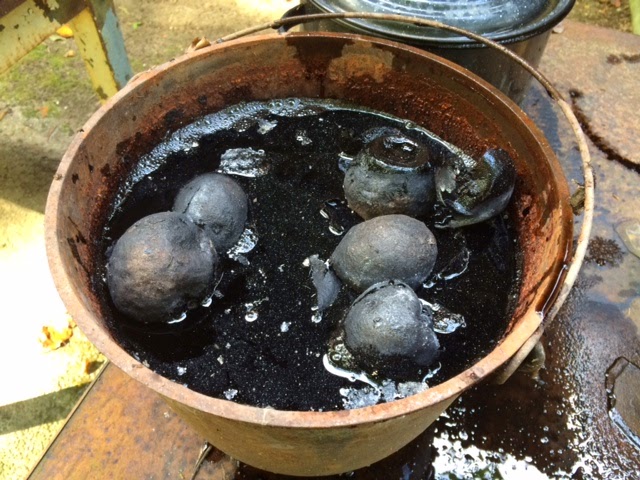
Even today we see DIY movements popping up across the globe where artists seek a return to low-tech and historical processes that include hands-on and the identifiable touch of the artist. As for myself, I am very interested in natural materials for painting, dying, printing and drawing. Gathering walnuts in the fall is a great way to bring a class to bonding camaraderie. Soaking and processing the nuts and hulls, (while students snap selfies with their bounty), renders wonderful brown liquid that is used for dying, drawing and printing. Suddenly those students see the tree, the nuts (fruit), the brown liquid, their iPhone and computer in a different way. Starting small can lead to bigger things..........Making connections and making art from those connections may be just what we need to get us through this "Brave New World".
Happy Labor Day !!
Walnuts in the shell with outer hull.
Walnuts with hulls in a cast iron pot soaking in water.


BTW, Hemp is a great natural material that (among other uses) renders oil, wax, resin, rope, cloth, pulp, paper, and fuel. All can be used in 'making'.

Wednesday, July 16, 2014

Thermal Response, Jane Allen Nodine


Mid-July and Forecasts Predict, "Polar-Vortex" is Back?

Warm up with my new catalog "Thermal Response"


• Works on paper and on panel.

• Available for sale and for solo exhibition or group shows.

• Please contact me for details: jane@janenodine.com

• See Jane in the studio.....

Monday, January 27, 2014

Sketchbooks, Journals, Notebooks ………....Collecting the Idea; Part II

I have had loads of if interest in the topic of artist's journals since I published Part I, so I am pleased to share with you several more artists on the topic "Sketchbooks, Journals, Notebooks…Collecting the Idea; Part II". I noted in the first post that it was dedicated to my students. I require a comprehensive approach to journaling and sketch booking in my courses, but I find most students resist the process and seem to view it as insignificant and unworthy of their time, a vantage not within my personal perspective. As I mentioned in Part I, journaling forms vary from artist to artist, but the collection, contemplation, research notes and visual thinking are consistent for us all. The act of recording the process is important to who we are as artists, and to the art we make. In many ways our journals and notes become our sounding board and assessment tool when we leave the cocoon of an educational system that students often take for granted with their daily access to peer comments and professor reviews.  So, in Part II we will look at several artists across the country who are well established in their studio practice and who rely journaling.

David A. Clark lives and works in Palm Springs, California. (Ahhh, warm sunny days in southern Cal, must be nice !!)  David's focus is on printmaking that includes traditional prints on paper, and installations where his iconic symbols emblazon environments. I love in his statement for this topic he said "Ideas are currency…to capture elusive bits of wonder..". So true. Capturing or recording ideas and bits of wonder are so very significant to growth and development of work.

David A. Clark uses Post-It notes grouped on his studio wall and diagrams and notations in books.
David told me, "Ideas are currency and when they get lost it's a terrible thing. I takes notes in many ways, both notebook and not. However the notes are manifested, they are an effort to catch thoughts and the golden nuggets before they drift back into the river where they have to be panned for again or float downstream to someone else. I keep notes in books, on cards (mostly to notate color) and I make hundreds of notes on Post its which litter the walls of my studio. They are my effort to capture the elusive bits of wonder that come drifting by and yet so easily flutter away if they are not in some way caught and recorded. Some of these written seeds lay dormant, germinating for many years before they have their day in the sun." David A. Clark

Eileen Goldenberg holds degrees in ceramics and glass and works extensively in encaustic wax. Living and working in San Francisco, Eileen is active in arts festivals and American Craft Council exhibitions across the country. Traveling and exhibiting work in these temporary presentation systems requires a high level of organization and discipline. In my observations Eileen is proficient in both and she has also developed strengths in marketing her work. Eileen is very grounded in drawing, and from her posts I see from time to time, it is evident she uses drawing as a practice like musicians use scales and as reference for surface patterns and configurations in her work. 
Eileen said, "I draw for my paintings, planning and trying concepts and I also create drawings that are a different thing. I have sold complete sketchbooks...the leather ones here are my favorites...and I have hundreds of different books…" Eileen Goldenberg.
Organization and detail are hallmarks of Eileen Goldenberg's journaling. She has sold completed
sketchbooks to collectors. The lovely leader bound ones are handmade by a bookmaker.


Friend and fellow artist Toby Sisson lives in Worcester Massachusetts where she is Assistant Professor of Studio Art at Clark University. When Toby saw my interest in journaling she was generous to share with me a PowerPoint of artist sketchbooks she uses with her students. Here are a few examples I found of interest:

A selection of artist books and pages Toby Sisson uses in teaching her students the importance of journals.
I like the tactile and visual qualities of the assemblage piece.
"I do know that it's been a crucial and constant part of my studio practice. My sketchbooks are where I can feel safe placing the barest glimmer of an idea, the faintest whiff of what may (or may not) become something real and possibly seismic to my work. I really cannot imagine not having a sketchbook near, always at the ready, just in case. you can quote me on that!" Toby Sission


Jeffrey Hirst is prolific in several areas with work in both two and three dimensions that often takes the form of installation. In Jeffrey's artist statement he says,  
" I create shaped abstract paintings that function as fragments and are often exhibited as installations where the sum of the parts is greater than the whole. " Jeffrey Hirst
The selections of the working images he sent, directly reflect his statement about fragments and parts rendering something larger than the whole. Here I am showing a group of finished works in the first three images with a selection of working images below.
Finished panels by Jeffery Hirst.

Selections of working images  from sketchbook pages by Jeffery Hirst.


Ann Stoddard's journals accumulated on her bookcase.
Ann Stoddard, director of the Harper Gallery at Presbyterian College in Clinton, SC, works in a variety media developing relief paintings, sculpture and installations. I have know Ann for many years and her interest in journaling parallels my own. She shared a photo of her sketchbooks assembled on a small bookcase. An avid collector, Ann notes in her artist statement, "I cannot help myself but create and explore and for some reason there is a common denominator that resurfaces; it is associated with quilts, with cutting, piecing, sections of memory, patterns…Ann Stoddard.  That idea of piecing, assembling, and seeing something develop from those parts is the thread that binds us all as artists.


There are thousands of journals and sketchbooks in closets, attics, garages and studios. They hold insights to their makers and maintain secrets that will never be deciphered. I hope this post has given you fresh eyes toward the collection of material we use to create, and might just spur you to get out your books and look back at the journey traveled.  

My thanks to the artists that were willing to share their personal sketches and journals.

Happy sketching !!

Saturday, January 18, 2014

Sketchbooks, Journals, Notebooks ………....Collecting the Idea; Part I

This post is specifically dedicated to my students…..

I have sketchbooks, journals, notes, notations, diagrams and specs. I have kept them in one form or another since I was a child. The most comprehensive ones go back to my days in high school. I'm always on the lookout for new blank books that can be used at a moments notice to record ideas, jot down quotes, document technical info, add wisdom or a bit of humor. My journals serve as a record, a file, a documentary dictionary and encyclopedia. It is the way I collect my thoughts and try to make sense of experiences, ideas and life, things I want to know and try to understand. I take great pleasure in looking back at those tomes and revisiting my interests and notions over the years.

Much of what I have collected makes sense only to me. That is because I jot, scribble, list, scratch diagrams, stick things in, tear things out, and assemble something that vaguely resembles qualities of hoarding. Literally, I am recording my cognitive thought process on those pages. Some artists are analytical, methodical, and highly meticulous with their journal notations, but more often I find most artists follow a similar process to mine that is along the lines of collecting for contemplation and reference.


A look back in history at journals of iconic artists reveals all sorts of insights into masterpieces that we as viewers may only know as finished works installed in museums. Most are familiar with the highly detailed notebooks of Leonardo da Vinci, who recorded more about science and engineering than art in his journals. Da Vinci was so meticulous and protective of his work that he wrote the text in reverse so it could not be read by outsiders. A more recent artist that comes to mind for copious notes and diagrams is Frida Kahlo whose journals have been published in one form or another and are very popular for studying her life and her art.


Detail: Journals of Frida Kahlo

Detail: Notebook of Leonardo da Vinci
Found items from books and magazines, or a printout from the web, have caused many a sketchbook to split its spine. While my past sketchbooks include torn pages and slips of paper, today I see much of that same content material posted on my Facebook page. I tend to select and share items of interest and humor. Those posts have become a resource and a record for my ideas just like my bound journals have for so many years. An outsider looking at my journals or my Facebook posts would see threads that have followed my thoughts and ideas throughout my career. A musician friend that performs and writes about music mentioned that he now keeps everything electronically on his phone or iPad since he is currently living on a boat in southern California. The forms may be changing, but the inclination to collect, organize, order and revise stays the same.

For this post, Part I & Part II, I invited several friends to share their journaling process and their forms of notation with statements and images. All of the individuals are creatives working in a variety of styles and media.


Deborah Kapoor lives and works in Seattle. Deborah has background in photography, painting and drawing, and is current working in sculpture and installation. Several ways she uses journaling is jotting ideas on Post-It notes, lined note paper, Moleskin journals and small travel journals. Relating to my earlier comment of how Facebook posts have become a journal for me, Deborah mentioned her smart phone has become a way to record notes electronically.

"… to simply jot an idea down before I forget it ­ when I¹m in a hurry.  I have ideas at the oddest times and just worry that I will forget them (because I will), so am constantly writing things on post it notes. Another is on simple lined paper,....  I have always liked the ruled lines, even though I mostly ignore them.  I will do little thumbnail sketches  that are not detailed at all, but gives me a really rough and quick idea of the form I am thinking about, with lots of written verbal description.  I do this A LOT. The words are a way of brainstorming as the ideas come, with no judgment at this time.  I may or may not use any of them." Deborah Kapoor
Deborah Kapoor examples of journaling/notations.
Note the small travel journals that she can carry in a pocket or purse.
I like that Deborah mentioned she delays or avoids judgement at this early stage of collecting notations. I emphasize to my students the importance of delaying judgement in the early stages of brainstorming ideas. Also, for organizing purposes Deborah uses typical manila office folders and files notes according to topic or project. 

Terry Jarrard-Dimond lives in Clemson, South Carolina where she works in fibers as surface design and sculptural form. On the issue of netting a fleeting idea she says,
"Anyone who doesn’t keep some type of notes on ideas for future work in my opinion is really playing fast and loose with their creativity.  You have a flash of an idea and you think you will remember it but often what seemed so vivid one minute can fade very quickly in our fast paced modern world.

Terry Jarrad-Dimond journals and notebooks. Note the office-organizer tabs she uses.
I keep journals with thumbnail sketches, written notes, tear sheets of images that catch my eye, scraps of fabric that don’t make it into completed work, file cards with ideas scribbled on them, color samples and anything else which might go into the stew of art making.  Sometimes things get pinned to my wall where I study them in a casual way.  Other times items just float around my studio where I discover and rediscover them as materials get shifted and sorted. My journals serve the singular purpose of igniting ideas that can be developed into finished works of art." Terry Jarrard-Dimond


Also living and working in South Carolina, artist Debbie Cooke told me she has kept journals for over thirty years. Her journals like her life, are an evolving process.

Journals by Debbie Cooke. Notice hr collections include tiny 
watercolors, pressed leaves, stamps, notes & diagrams
"In the beginning, I purchased journals and carried them to be able to record observations and ideas---some writings and drawings were for inspiration, and some were notes and sketches just as record. I found myself thinking, "I wish this journal was smaller, lighter, had better quality paper, etc."......and so I began making my journals. Because I designed it to easily fit in a camera bag or pocketbook, I began carrying them with me.... and my entries became less about ideas for new work, and more about my observations...more drawings, watercolors, and collage accompanied my writings….I still collage random objects---sugar packets, labels, ticket stubs, etc. These would serve as writing prompts for my musings, which would often lead to Internet searches on things I wanted to know more about "Debbie Cooke


In 1997 when Debbie accepted a position teaching photography, her journals underwent a major change becoming more about writing, notations and musings, and less about images since she was capturing those with the camera. Now that she has retired from teaching her studio work is focused on the gum dichromate photo process, known for demanding precision to gain success. Her journals now reflect detailed notes on chemistry, times, humidity, etc. Because these are based on utility, she pointed out they do not "feed my soul" as the previous books. Her solution has been to revisit her earlier process of collection by maintaining a separate journal for observational and musing purposes.


In Part II we will look at more collections and musings by creatives and I will share my personal collections.